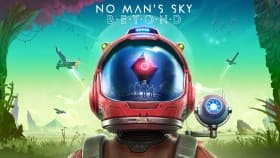
No Man's Sky is an action-adventuresurvival game developed and published by Hello Games. It was released worldwide for the PlayStation 4 and Windows in August 2016, for Xbox One in July 2018, for the PlayStation 5 and Xbox Series X and Series S consoles in November 2020, for Nintendo Switch in October 2022, for macOS in June 2023, and Nintendo Switch 2 in June 2025. The game is built around four pillars: exploration, survival, combat, and trading. Players can engage with the entirety of a procedurally generated deterministic open world universe, which includes over 18 quintillion planets. Through the game's procedural generation system, planets have their own ecosystems with unique forms of flora and fauna, and various alien species may engage the player in combat or trade within planetary systems. Players advance in the game by mining for resources to power and improve their equipment, buying and selling resources using currencies earned by documenting flora and fauna or trading with the aforementioned lifeforms, building planetary bases and expanding space fleets, or otherwise following the game's overarching plot by seeking out the mystery around the entity known as The Atlas.
Sean Murray, the founder of Hello Games, wanted to create a game that captured the sense of exploration and optimism of science fiction literature and art of the 1970s and 1980s. The game was developed over three years by a small team at Hello Games with promotional and publishing help from Sony Interactive Entertainment. The gaming media saw this as an ambitious project for a small team, and Murray and Hello Games drew significant attention leading to its release.
No Man's Sky received mixed reviews at its 2016 launch, with some critics praising the technical achievements of the procedurally generated universe, while others considered the gameplay lackluster and repetitive. However, the critical response was marred by the lack of several features that had been reported to be in the game, particularly multiplayer capabilities. The game was further criticised due to Hello Games's lack of communication in the months following the launch, creating backlash from some of its players. Murray later stated that Hello Games had failed to control hype around the game and the larger-than-expected player count at launch, and since then have taken an approach of remaining quiet about updates to the game until they are nearly ready to release. The promotion and marketing for No Man's Sky became a subject of debate and has been cited as an example of what to avoid in video game marketing.
Since the game's initial release, Hello Games has continued to improve and expand No Man's Sky to achieve the vision of the experience they wanted to build. The game has received a plethora of free major content updates that have added several previously missing features, such as multiplayer components, while adding features like surface vehicles, base-building, space fleet management, cross-platform play, and virtual reality support. This has substantially improved No Man's Sky's overall reception, with multiple websites citing it as one of the greatest redemption stories in the gaming industry.
Gameplay
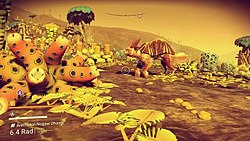
No Man's Sky allows players to explore planets with procedurally generated flora and fauna.
No Man's Sky is an action-adventuresurvival game played from a first or third person perspective that allows players to engage in four principal activities: exploration, survival, combat, and trading. The player takes the role of a specimen of alien humanoid planetary explorer, known in-game as a Traveller or Anomaly, in an uncharted universe. He starts on a randomized planet near a crashed spacecraft towards the edge of the galaxy and is equipped with a survival exosuit with a jetpack and a "multitool" that can be used to scan, mine and collect resources as well as to attack or defend himself from creatures and hostile forces. The player can collect, repair, and refuel the craft, allowing him to travel about the planet, between other planets and space stations in the local planetary system, engage in space combat with alien factions, or make hyperspace jumps to other star systems. While the game is open-ended, the player may follow the guidance of the entity known as The Atlas to head toward the centre of the galaxy.
The defining feature of No Man's Sky is that nearly all parts of the galaxy, including stars, planets, flora and fauna on these planets, and sentient alien encounters, are created through procedural generation using deterministic algorithms and random number generators from a single seed number. This 64-bit value leads to there being over 18 quintillion (1.8×10¹⁹) planets to explore within the game. Very little data is stored on the game's servers, as all elements of the game are created through deterministic calculations when the player is near them, assuring that other players will see the same elements as another player by travelling to the same location in the galaxy. The player may make temporary changes on planets, such as mining resources, but these changes are not tracked once the player leaves that vicinity. Until July 2020, the game used different servers for each platform versions; following a July 2020 patch, cross-platform play was enabled for all supported platforms.
Through exploration, the player is credited with units, the main in-game currency, by scanning planets, alien bases, flora and fauna in their travels. If the player is first to discover one of these, he can earn additional units by uploading this information to The Atlas, as well as having his name credited with the discovery to be seen by other players. Players have the opportunity to rename these features at this point within limits set by a content filter.No Man's Sky can be played offline, but interaction with The Atlas requires online connectivity.
The player must assure the survival of the Traveller, as many planets have dangerous atmospheres such as extreme temperatures, toxic gases, and dangerous storms. Though the player can seek shelter at alien bases or caves, these environments will wear away at the exosuit's hazard protection module and can kill the Traveller. Thus the player must collect resources necessary for survival. By collecting blueprints, the player can use resources to craft upgrades to his exosuit, multitool, and spacecraft to make survival easier, with several of these upgrades working in synergistic manners to improve the survivability and capabilities of the Traveller. Each of these elements have a limited number of slots for both upgrades and resource space, requiring the player to manage inventories and feature sets, though the player can either gain new slots for the exosuit or purchase new ships and multitools with more slots. The player may also buy additional slots for his starship or use storage augmentations. Many features of the exosuit, multitool, and spacecraft need to be refueled after prolonged use, using collected resources as a fuel source.
While on a planet, the Traveller may be attacked by hostile creatures. He also may be attacked by Sentinels, a self-replicating robot force that patrols the planets and takes action against those that take the planet's resources or attack peaceful fauna. Players may also be attacked for taking special resources, such as graviton cubes, or directly assaulting sentinels. The player can fend these off using the weapons installed on the multitool. The game uses a "wanted level". Low wanted levels may cause small drones to appear which may be easily fought off, while walking machines, such as the Walker or Quad can assault the player at higher wanted levels. While in space, the Traveller may be attacked by pirates seeking cargo, or by alien factions with whom he has a poor reputation. The player can use the ship's weapon systems to engage in these battles. Should the Traveller die on a planet, he'll be respawned at his last save point without his exosuit's inventory; the player can recover these materials if the player can reach the last death location. The player cannot respawn if playing on Permadeath mode. If the Traveller dies in space, he will similarly respawn at the local system's space station, but having lost all the goods aboard his ship. Again, these goods can be recovered by travelling to the point at which the player died in space, but with the added uncertainty of pirates claiming the goods first.
Most star systems have a space station where the Traveller can trade resources, multitools, and ships, and interact with one or more aliens from three different races that populate the galaxy as well as other travellers. Trading posts on planets offer similar functions. Each alien race has its own language, with word-for-word substitutions which initially will be nonsense to the player. By frequent communications with that race, as well as finding monoliths scattered on planets that help in translating, the player can better understand these languages and perform proper actions when interacting with the alien non-player characters, gaining favour from the alien and its race for future trading and combat. Consequentially, improper responses to aliens may cause them to dislike the Traveller, and their space-bound fleets may attack the Traveller on sight. The game includes a free market galactic store accessible at space stations and trading posts, where some resources and goods have higher values in some systems compared to others, enabling the player to profit on resource gathering and subsequent trade.
The game has deep crafting capabilities, allowing players to craft technology upgrades, components for more complex items, tradable resources, base construction parts, food and ammo. Crafting requires blueprints, which are unlocked by digging up data modules and trading them in at space stations. Resources are stored in inventories in the player's exosuit, ship, freighter, exocraft, nutrient processor, and storage containers. Resources can be processed into other resources using refiners or nutrient processors, allowing all kinds of food to be created.
No Man's Sky is primarily designed as a single-player game, though discoveries can be shared to all players via the Steam Workshop, and friends can track each other on the game's galactic map. Hello Games's Sean Murray stated that one might spend about forty hours of game-time to reach the centre of the galaxy if no side activities are performed, but he also said that he fully anticipated that players would play the game in a manner that suits them, such as having those that might try to catalogue the flora and fauna in the universe, while others may attempt to set up trade routes between planets. Players can track friends on the galactic map and the system maps. Due to limited multiplayer aspects at launch, Sony did not require PlayStation 4 users to have a PlayStation Plus subscription to play the game online.
Post-release updates
Since its release, No Man's Sky has gained numerous free updates which have added in new gameplay features, including those originally envisioned by Hello Games but not included by release such as base building, alongside gameplay and engine improvements, quality of life features, and bug fixes. Murray said that such expansions to bring in new features were more appropriate than offering downloadable content due to the procedural generation systems within the game. Former Sony executive Shahid Ahmad, who led Sony's efforts to get No Man's Sky, stated that Hello Games had a planned schedule of updates for the game as early as 2013. With the release of "Sentinel" in February 2022, Murray said that Hello Games considers No Man's Sky nowhere near finished, as "the team are always coming up with new things that they want to do with the game: new content and features and areas for improvement." Later patches starting with "Worlds, Part One", were based on technology and gameplay that Hello Games had developed for their next game, Light No Fire, and brought into No Man's Sky.
With the "Expeditions" update in March 2021, the game has introduced time-limited Expeditions that are curated experiences to introduce various features of the gameplay through milestones. Players can earn rewards consisting of customization options that can be redeemed in any other saved game. For example, one such reward during the second seasonal expedition was the ability to unlock a version of the Normandy, the spacecraft from the Mass Effect series from BioWare, coinciding with the release of Mass Effect Legendary Edition. Another Expedition in October 2021 just ahead of both Halloween and the release of the theatrical Dune adaptation, introduced giant worms to the game's fauna. A seventh expedition named "Leviathan", released in May 2022, introduced "space whale" organic frigates, which can be recruited into a player's frigate fleet. More recently, Expeditions have been released after each major update to introduce the new gameplay features of that update to the player, and with the "Omega" update, players can start an Expedition with an existing character, bringing in a limited set of resources to help them get started, and then return with their gains back into their original save at the conclusion of the expedition.
Plot
The Traveller (the player character) wakes up on a remote planet with amnesia and must locate their crashed starship. After finding their starship, its computer guides the Traveller to make the necessary repairs and to collect the resources needed to fuel a hyperspace jump to another planetary system. En route, the Traveller encounters individual members of three alien species, the Gek, the Korvax and the Vy'keen, that inhabit the galaxy. During their voyage, the Traveller is compelled by an unknown force to reach the centre of the galaxy.
Along the way to the centre, the Traveller is alerted to a presence of an anomaly in a nearby system. Travelling there, they find a special space station ("The Space Anomaly") where many strange aliens reside. Two of the aliens, Priest Entity Nada and Specialist Polo, have knowledge beyond what other aliens in the galaxy appear to possess, including being able to speak to the Traveller without translation. They tell of a strange being, found at the centre of the galaxy, and are able to guide the Traveller towards meeting it by directing them to a nearby black hole that can quickly take the Traveller closer to the centre of the galaxy.
As the Traveller continues on their journey, they begin receiving messages from an alien entity named Artemis. Artemis says that they are also a "Traveller" and wished to meet others of their kind, but were trapped on a sunless world after stepping through a strange, ancient portal. After triangulating Artemis' position and seeking help from the local alien species, the Traveller discovers that Artemis' location does not exist. Upon telling Artemis the news, the transmission ends mysteriously and the Traveller learns of yet another Traveller named Apollo.
The Traveller contacts Apollo, telling them about Artemis' predicament. They are instructed by Apollo to uncover the connection between the portals and the Sentinels, the robotic beings protecting each planet. After a skirmish with the Sentinels, the Traveller passes through a portal and is taken aboard a large, unknown vessel in space, where they come face to face with the cosmic being Nada spoke about, named the Atlas. The Traveller is then sent to an unknown planet where they find the grave of Artemis, revealing Artemis has been dead the entire time. While trying to contact Apollo, the Traveller accidentally contacts a new entity named -null-, who tells the Traveller that Artemis can be saved using a "Mind Ark". Once they construct the Mind Ark, the Traveller is told to choose whether to upload Artemis' soul into a machine aboard the Anomaly or to let them die. Regardless of the choice, the Traveller is directed by a distress beacon to another portal where they learn that the Atlas is dying.
The Traveller becomes aware that they, like Nada and Polo, are unique from the other sentient beings in the galaxy, having some sense of the universe's construction and nature. It is revealed that the galaxy itself exists as a computer simulation managed by the Atlas, and the Travellers are entities that were created by the Atlas to explore the simulation. It is also revealed how Nada and Polo met, and how they are "errors" that had become self-aware of being in a simulation and isolated themselves in the Anomaly to help others.
The Traveller investigates more Interfaces and finds themselves once again in direct communication with the Atlas, where it informs the Traveller that it does not want to die. In order to save itself, it directs the Traveller to continue to explore and collect information all while moving towards the centre, where the entity appears to be. The Atlas judges the Traveller's progress and grants them the blueprint for a different Atlas Seed if it deems the Traveller worthy, as well as portal glyphs to aid in reaching the core. As the Traveller gets closer, they receive messages from Apollo and -null-, and help from Nada, Polo, and Atlas Seeds from other Interfaces.
Ultimately, the Traveller reaches the galaxy's centre, finding one final Atlas Interface. The Traveller must choose to either restart the simulation, saving the Atlas, or reject the offer.
If the Traveller chooses to reject the Atlas' offer, the main storyline ends and the Traveller is allowed to explore the galaxy as they wish. Otherwise, if the Traveller chooses to restart the simulation, the Atlas resets, upon which it creates a new galaxy and a new Traveller entity to restart the exploration. It is then revealed that this has happened many times before, each time shortening the life of the Atlas. The Atlas tries to observe the future past its death, but sees nothing, besides the hand of its creator on its glass casing. The Traveller is teleported to the new galaxy, effectively restarting the game.
OverviewIn No Mans Sky, Multi-Tools serve as indispensable companions for interstellar exploration, combat, and resource gathering. This guide provides a comprehensive framework for optimizing Multi-To…
OverviewNo Mans Sky’s Photo Mode transforms interstellar exploration into an artistic journey, allowing players to capture breathtaking alien landscapes, exotic creatures, and architectural marvels. T…
Master Sentinel Interceptor acquisition in No Mans Sky through Dissonant System exploration and Capital Ship combat. Learn Echo Locator strategies, Harmonic Interface decryption, and Hyaline Brain puri…



















 USD USD
 EUR EUR
 GBP GBP
 CAD CAD
 AUD AUD